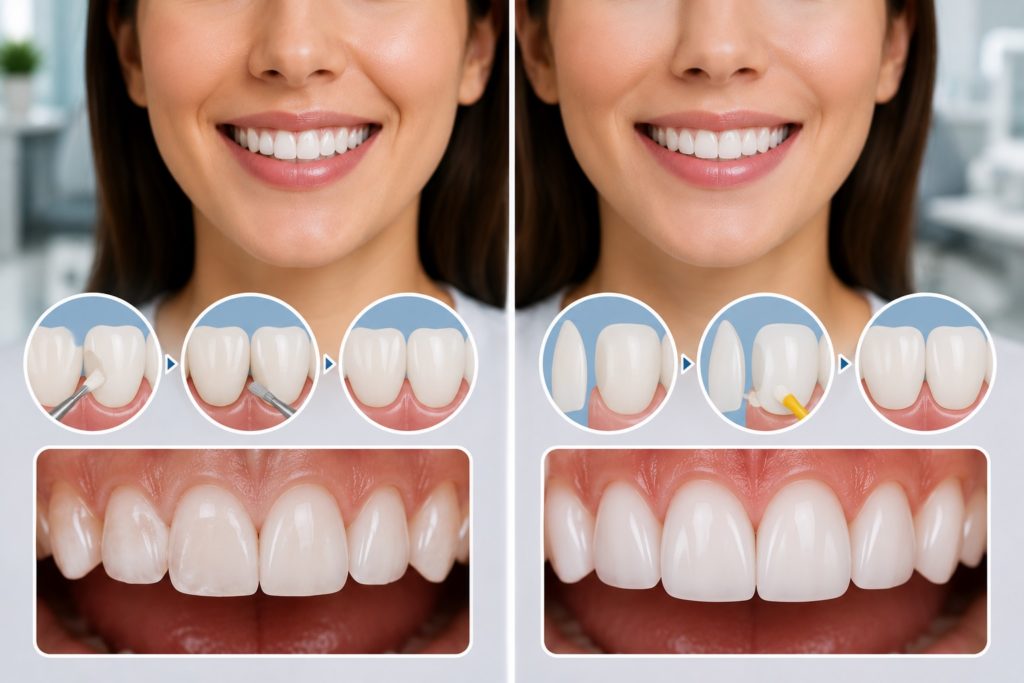
Composite vs Porcelain Veneers: Which Lasts Longer and Looks Better?
You’ve read four articles already, and you’re somehow more confused than when you started. One says composite veneers are fine, while another says you should always go for porcelain veneers. Prices range from “surprisingly affordable” to “please sit down before you read this.” Nobody seems to agree on anything.
Here’s a version that just tells you what’s actually true: “composite or porcelain veneers?”
22 JUNE 2026

Table of Contents
The Core Difference Between Composite Vs Porcelain Veneers
Whether it is composite veneers or porcelain veneers, both do the same job. A thin shell bonds to the front of your tooth and changes what people see when you smile. The shape, colour, length, that edge that’s bothered you for years. The difference is in how that shell gets made, and that part matters more than most people realise.
Composite veneers are built directly onto your teeth in the chair. Your dentist uses a tooth-coloured resin, sculpts it layer by layer by hand, polishes it up, and you’re done. No lab, no wait. You drive home with a new smile the same day.
Porcelain veneers involve a specialist ceramist making each veneer by hand in a dental lab. Your dentist takes impressions, you agree on shape and shade, those specs go to the ceramist, and a few weeks later, the finished restorations come back to be bonded permanently. You wear temporaries in between.
“Sculpted chairside by your dentist” versus “hand-crafted in a lab by someone who does nothing else.” That gap is exactly why the two options perform so differently once you’re living with them day to day.
How Long Do Composite Vs Porcelain Veneers Last?
Nobody wants to spend money on their smile and be back in the same conversation three years later.
Composite veneers last around 5 to 7 years for most people. The resin is slightly porous, so it gradually picks up colour from coffee, red wine, and food. That bright result from day one starts shifting by year two or three. The surface also scuffs under daily biting pressure, and you’ll end up back for polishing touch-ups more often than you’d expected.
Porcelain veneers, looked after properly, last 10 to 20 years. The glazed ceramic surface doesn’t absorb staining. It keeps its polish. It handles chewing far better than resin. And because it was precision-made in a lab rather than sculpted freehand, the fit is tighter and the bond is more durable over time.
Here’s the cost most people never run when comparing composite vs porcelain veneers:
| Composite | Porcelain | |
|---|---|---|
| Cost per tooth (Australia) | $400 to $900 | $1,500 to $2,500 |
| Lifespan | 5 to 7 years | 10 to 20 years |
| Replacements over 15 years | 2 to 3 times | Stain resistance |
| Repairability | Easy to fix | Usually needs replacing |
| Appointments needed | One | Two to three |
Factor in replacements, and the 15-year total often lands in similar territory for both, be it composite veneers or porcelain veneers. Except one looked better the entire time.
Which One Looks More Natural?
Both look great on day one. The before-and-afters don’t show you year four.
Natural tooth enamel is semi-translucent. Light doesn’t just bounce off it; it travels in, scatters, and comes back out. That’s what gives teeth their depth and that alive quality. Porcelain behaves almost identically. A skilled ceramist builds different translucency levels into a single veneer, so it responds to light the way a real tooth does. Across a dinner table, in photos, on a bright day outside, you genuinely cannot tell.
Composite is more opaque. Light bounces off the surface rather than travelling through it, which reads as slightly flat in strong lighting or photographs. Add gradual staining over the years on top of that, and the gap between the two becomes very obvious, very fast.
What About the Procedure?
Composite veneers are low-pressure. One appointment, everything done chairside, you leave the same day. Very little enamel is touched, which makes it more reversible and a genuinely good option if you want to trial something before committing to anything permanent.
Porcelain veneers take a few weeks across a couple of visits:
- First visit: Teeth lightly prepared, impressions or scans taken, temporary veneers fitted
- In between: Your ceramist hand-crafts the final restorations
- Second visit: Permanent veneers bonded, adjusted, and polished
The stage most people don’t know to ask about is the mock-up. Before any preparation happens, good clinics show you the proposed shape and size on your actual face so you can respond before anything is permanent. That moment where you say “make the edges softer” or “I want them slightly longer” is worth its weight in gold.
One thing to be upfront about: porcelain requires removing a thin layer of enamel, and that can’t be undone. Not a reason to avoid it. A reason to be completely sure of the person doing it.
When Composite Is the Right Call
Composite gets unfairly dismissed in comparison articles because it’s always being held against porcelain’s lifespan numbers. But it genuinely makes sense when:
- You’re fixing one or two teeth, not a full smile
- Budget is the immediate priority and you’re fine with a shorter lifespan
- You’re younger and your face is still settling
- You want to trial a shape or shade before committing to something permanent
- You need something done quickly before an event
Be honest with yourself about what it is, though. A solid, shorter-term solution, not a like-for-like replacement for porcelain. No shame in that being exactly what you need right now.
When Porcelain Is the Obvious Call
For a full smile transformation, porcelain is where the evidence points every time. It makes the most sense when:
- You’re treating multiple teeth across your whole smile
- You want to do this once and not think about it again for 15 years
- Staining matters because you drink coffee daily and you’re not stopping
- You want results that look undetectable in every situation, photos included
- You’re treating this as a real long-term investment in how you show up every day
Composite veneers rarely deliver what people were picturing for a full makeover. The depth isn’t there. The staying power isn’t there. Porcelain, placed by experienced hands backed by a skilled ceramist, is where that picture actually becomes real.
What Makes Veneers Last
The material is half the story. Your daily habits write the other half:
- Night grinding is the biggest threat to any veneer. A custom night guard is non-negotiable if you grind. It’s what stands between you and a cracked veneer at 2 am
- Biting hard foods directly with veneered front teeth puts concentrated stress where it shouldn’t be. Cut things up, use your back teeth
- Skipping check-ups lets small margin issues quietly become bigger problems
- Daily flossing keeps the gum line healthy, which protects the veneer edges over time
- Soft brush and non-abrasive toothpaste preserve the surface. Anything gritty wears it faster than most people realise
None of this is hard. It’s just the difference between a result that still looks brilliant in year 10 and one that looks tired in year 4.
The Verdict
Composite veneers are a real option for the right person in the right situation. But for longevity, natural aesthetics, and a result that holds its value over time, porcelain isn’t a close comparison. It costs more upfront and gives you considerably more back. Better looking, longer lasting, less maintenance. For anyone serious about their smile, the path usually leads here. The only question left is who’s doing it.
About Porcelain Veneers Sydney
The team at Porcelain Veneers Sydney brings over 30 years of combined cosmetic dentistry experience to every case, working with a master ceramist on every single restoration. Every patient goes through a full smile design process, mock-up included, before a single tooth is prepared. Our clinic is in Sydney CBD with free on-site parking, and interest-free payment plans start from just $100 per week.
Call (02) 8045 5138 or book your consultation today.
FAQs
Q1. What is the main difference between composite vs porcelain veneers?
Composite is sculpted directly onto your teeth chairside in one visit. Porcelain is custom-made by a ceramist in a lab and bonded over two or three visits. Porcelain lasts longer, resists staining, and looks more natural over time.
Q2. How long do composite veneers vs porcelain veneers last?
Composite typically lasts 5 to 7 years. Porcelain lasts 10 to 20 years with proper care. That gap is one of the strongest practical reasons to choose porcelain for a full smile makeover.
Q3. Do porcelain veneers look more natural than composite?
Generally, yes, especially over time. Porcelain transmits light the way natural enamel does, giving each veneer real depth. Composite is more opaque and stains gradually in a way that porcelain’s glazed surface doesn’t.
Q4. Can I start with composite or porcelain veneers and switch later?
Yes. Many patients start with composite and move to porcelain when they’re ready. Because composite involves minimal enamel removal, switching later is straightforward.
Q5. Are composite veneers worth it or should I just go with porcelain?
Composite makes sense for minor fixes or when the budget is the immediate concern. For a full makeover, porcelain is almost always the better long-term investment.
Q6. What habits most affect how long veneers last?
Night grinding is the biggest one. A night guard is essential if you grind. Beyond that, biting hard foods with veneered teeth, skipping check-ups, and poor daily hygiene all shorten lifespan considerably.
Here's One More Reason to smile...

🏢 Suite 416, Level 4/307 Pitt St, Sydney NSW 2000
📸 Instagram @porcelainveneers.sydney
