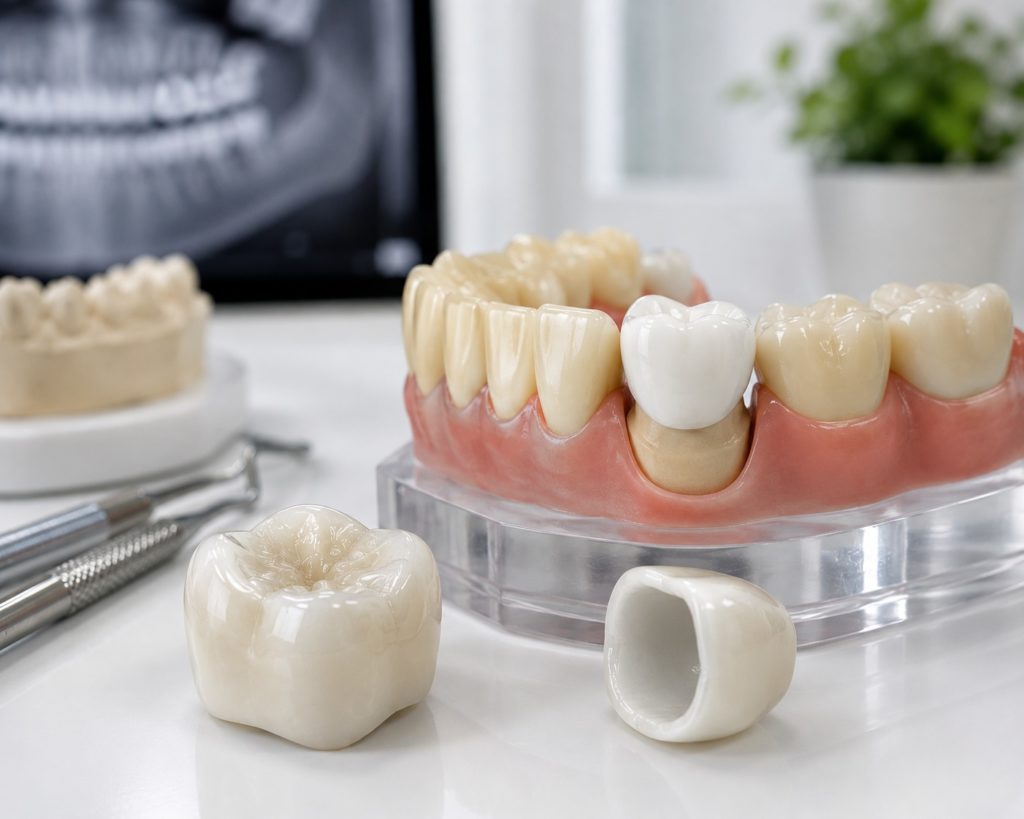
Could a Zirconia Crown Be Changing the Future of Smile Rehabilitation?
Fixing a damaged tooth used to just mean getting it working again. That’s not really enough anymore. Patients now want something that feels like their own tooth, holds up for years, keeps as much natural structure as possible, and blends in well enough that nobody ever clocks it’s a restoration. That shift has pushed dentistry a long way past the materials that used to be standard.
10 August 2026

Table of Contents
Of everything available right now, the zirconia crown is probably the biggest development in modern smile rehabilitation. It’s strong enough to handle a heavily used back molar, and yet it can still look right sitting somewhere visible in the mouth. That combination has genuinely changed how dentists approach the harder restorative cases.
If you’re considering crowns for teeth, it’s worth understanding why zirconia is becoming such an important part of modern smile rehabilitation.
Key Takeaways
- A zirconia crown gives you real strength without the compromise on how it looks.
- You often don’t need to sacrifice healthy tooth structure to get a durable result anymore.
- Real smile rehabilitation is rarely one crown fixing one tooth; it’s usually a few things working together.
- What material makes sense depends on your bite, where the tooth sits, and what you want out of it.
- Digital planning has quietly made crowns fit better and last longer than they used to.
- Chasing the lowest tooth crown cost can end up costing more, just later.
Why Is the Zirconia Crown Becoming the Preferred Choice for Complex Restorations?
Ask a dentist why zirconia’s taken off and you’ll usually get the same answer: it doesn’t force a trade-off. Strong, precise, and it still looks right. That combination is rare, and it’s exactly why it works so well for people who need something built to last without an obvious giveaway in the mirror.
Not every broken tooth is the same story. Some have a filling from fifteen years ago that’s finally given up. Some have had a root canal and are more fragile because of it. Others are just worn flat from grinding through the night for years without anyone noticing.
Treatment planning has changed a lot too. It used to be “patch the hole.” Now a dentist’s looking at how one restoration sits inside your whole bite, your face, your gums, whether the rest of your mouth is stable enough to support it long-term.
Zirconia fits that mindset well:
- It resists fracture better than most alternatives
- It wears down evenly instead of chipping unpredictably
- Gum tissue tends to tolerate it well
- It can be manufactured with real precision digitally
- The colour doesn’t shift or dull over time
- It’s less prone to chipping than a lot of layered ceramics
For context, the American College of Prosthodontists puts implant-supported crown placements in the US at roughly 2.3 million a year, and that’s before you count all the crowns going onto natural teeth. Stronger ceramics like zirconia have become a bigger part of that picture as the numbers grow.
Modern Smile Rehabilitation Is About Much More Than One Tooth
Here’s something patients don’t always expect: fixing “the tooth” usually isn’t the whole job anymore. Rehabilitation now means looking at the whole mouth, how everything works together, not just patching whatever’s broken.
Used to be, one bad tooth got one fix, and that was that. Dentistry doesn’t really work that narrowly anymore.
What gets looked at now:
- How the bite lines up
- How the jaw moves and functions
- Wear patterns across all the teeth, not just the obvious one
- Gum health
- Whatever restorations are already sitting in the mouth
- Facial symmetry
- Where things are likely headed if nothing changes
Say someone comes in with three cracked molars. It’s tempting to think that’s just three crowns for teeth and done. Often it’s not. There might be a grinding habit to deal with, an old failing filling to sort out first, or a bite that needs correcting before any new crown goes anywhere near it.
Take the wider view, and the results tend to hold up years later instead of falling apart again.
Why Material Selection Matters More Than Many Patients Realise
The material isn’t just about looks. It decides how long the crown lasts, how it feels, how much maintenance it needs down the track. Porcelain crowns are still a genuinely good option a lot of the time, but zirconia earns its keep with patients who grind, clench, or just need something built for heavier use.
A lot of people assume a crown is a crown; material doesn’t really matter.
It really does.
Here’s roughly how it breaks down:
| Material | Best For | Key Benefit |
|---|---|---|
| Zirconia | Heavy bite forces, molars, full-mouth rehabilitation | Exceptional strength |
| Porcelain Crowns | Highly aesthetic front teeth | Superior translucency |
| Porcelain fused to metal | Some traditional restorations | Proven long-term history |
| Gold alloys | Selected posterior teeth | Outstanding durability |
A gorgeous crown that can’t handle years of actual chewing isn’t really a win. Looks and function both have to hold up.
What a Quality Before Photo Should Show
Digital scanning and CAD/CAM design have quietly made a huge difference to how well dental crowns fit. Instead of eyeballing an impression and hoping for the best, a dentist can now design something that fits your bite and neighbouring teeth with a level of precision the old methods just couldn’t manage.
A lot of modern smile rehabilitation leans heavily on digital planning now; traditional impressions alone don’t really cut it for the more complex cases.
What digital tools let a dentist check:
- How your bite comes together, tooth by tooth
- The contours of each tooth
- Whether your smile looks symmetrical
- How thick the crown needs to be in different spots
- How tight the margins are
- How everything behaves when your jaw’s moving, not just resting
The restoration stops being a patch job and becomes something that’s genuinely been engineered to fit your mouth specifically.
A review in the Journal of Prosthodontic Research backs this up too, monolithic zirconia restorations showing survival rates over 95% at the five-year mark in plenty of studies, provided the case was planned and looked after properly.
When Might a Zirconia Crown Be Recommended?
Your dentist’s probably going to bring up zirconia when a tooth needs serious reinforcement, but you still care how it looks. It comes down to the tooth’s condition, what forces it’s under, and what you’re trying to achieve.
Zirconia tends to come up for:
- Large, failing fillings
- Cracked teeth
- Teeth that have already had a root canal
- Serious wear
- Broken cusps
- Implant-supported crowns
- Teeth that take a beating from grinding
A practical example
A patient in his early fifties came in with several molars fractured from years of clenching that nobody had ever really addressed.
He’d had fillings replaced over and over, and it just wasn’t holding.
After a proper look, zirconia restorations went in alongside a bite management plan. The point wasn’t just to fix what had already broken; it was to stop the next round of fractures before they happened.
That’s honestly become a pretty normal way of approaching cases like this now.
Does a Stronger Crown Mean Better Results?
Not on its own, no. Strength only matters if it’s backed by the right diagnosis and the right planning around it.
Patients ask a lot whether zirconia’s just “the best” crown, full stop.
It depends on a few things:
Tooth location
Front teeth sometimes look better with a different ceramic, depending on what you’re after aesthetically.
Bite force
If you grind, zirconia’s extra strength usually pays off.
Remaining tooth structure
How much healthy tooth is left changes how the crown gets shaped and designed.
Smile expectations
Some people want maximum translucency and a totally natural look. Others just want it to last. Rarely can you max out both at once.
A properly planned restoration weighs all of this together rather than chasing one factor in isolation.
Understanding Dental Crown Cost Beyond the Initial Price
It’s easy to look at dental crown cost as just a number on a quote. It’s worth looking at what that number buys you, because a well-made crown that lasts fifteen years can genuinely work out cheaper than a bargain option that needs replacing in five.
Comparing prices is completely understandable. Everyone does it.
But a lot goes into tooth crown cost:
- The material itself
- The digital technology behind it
- How the lab crafts it
- How complicated your case is
- Whether you need other treatment first
- Any bite rehabilitation involved
- The dentist’s experience level
Cheapest up front doesn’t always mean cheapest overall, not if it means going back for repairs or a redo down the line.
A proper consultation is really where a dentist should explain exactly why they’re recommending what they’re recommending, for your mouth specifically.
What Makes Successful Smile Rehabilitation Last?
The material matters, sure, but long-term success really comes down to planning, execution, and what happens afterwards. Even the best crown in the world needs healthy gums and a stable bite underneath it to hold up.
The patients who get the best results long-term tend to do a few things consistently:
- Keep up with regular check-ups
- Brush and floss properly at home
- Wear a night guard if it’s been recommended
- Get small issues sorted before they become big ones
- Show up to maintenance appointments
Smile rehabilitation works a lot better when it’s treated as something ongoing, not a single fix-it appointment you tick off and forget.
A zirconia crown isn’t just a stronger crown. It’s part of a bigger change in how dentistry gets planned now, digitally, personally, with an eye on keeping teeth intact and function working properly for years, not just fixing what’s broken today.
Paired with a proper diagnosis and real planning, zirconia can do a lot: protect a damaged tooth, restore confidence, support your bite for the long haul. The question worth asking isn’t which crown is strongest. It’s which one suits your mouth, your bite, and where things are headed.
About Porcelain Veneers Sydney
At Porcelain Veneers Sydney, treatment planning goes further than fixing whichever tooth is causing trouble. Every smile gets looked at as a whole system, using digital technology and evidence-based restorative work to get results that function properly, look natural, and last.
If you’re wondering whether a zirconia crown or a porcelain crown makes sense for you, book a proper consultation and get a plan built around your actual situation.
Frequently Asked Questions
1. Is a zirconia crown better than porcelain crowns?
Zirconia crowns are generally stronger than a lot of traditional porcelain crowns, which makes it a good fit for teeth under heavy bite force. What’s right for you depends on where the tooth is and what you want it to look like.
2. How long do dental crowns usually last?
Somewhere between 10 and 15 years for well-maintained dental crowns, and plenty go well beyond that. Comes down to hygiene, bite forces, regular care, and how well the treatment was planned to start with.
3. Are crowns for teeth recommended after root canal treatment?
Often, yes. A tooth that’s had a root canal tends to be more fragile, so a crown gets placed to protect and strengthen whatever’s left of it.
4. What affects dental crown cost?
Material, lab techniques, digital technology, how complicated the case is, and whether extra treatment’s needed beforehand. A proper consultation gives you the clearest picture.
5. Are dental caps for teeth the same as crowns?
Yes, just different wording for the same thing: a restoration that fully covers and protects a weakened tooth.
6. Can a zirconia crown look natural?
Yes, and zirconia crowns have come a long way on that front. Properly designed and matched, it can be genuinely hard to tell from a natural tooth. Your dentist will pick what balances how it looks with how it needs to hold up.
